Kigo
Kigo is the retrieval system behind Epos on chathaiku.com. It gives a 1.5B-parameter model access to a small, hand-curated knowledge base — and, just as importantly, decides when not to use it. This card describes what it retrieves from, how it decides, and what it does with your questions.
Overview
A small language model has a small memory. Epos knows a great deal about language and very little about last Tuesday, and — like every model its size — it fills gaps confidently rather than admitting them. Retrieval-augmented generation is the standard answer: search a document collection, put the best matches in front of the model, and let it read rather than recall.
In a haiku, the kigo is the seasonal word — a single term that points outside the poem to a whole shared body of knowledge the reader already has. That is the job here. Kigo is a local knowledge base that runs on Rootcomputer's own hardware alongside the model. There is no third-party search API, no external vector service, and no per-user document store. The whole index is a directory of plain-text files, a matrix of embeddings, and roughly two hundred lines of retrieval logic.
Kigo is live for Epos 2.1 at chathaiku.com. Most of the engineering in it is not retrieval — retrieval is one matrix multiply — but restraint: knowing when the knowledge base has nothing useful, and refusing to claim otherwise.
Specifications
Documents are chunked, embedded once at build time, and searched with a fused dense + lexical score. No approximate-nearest-neighbour index: at this scale an exact brute-force search is faster than the overhead of maintaining one, and it never returns an approximate answer.
(multi-qa-MiniLM-L6-cos-v1)
fused with BM25
(no ANN index)
per query
(public / internal)
From your question to a cited answer
Five stages, in order. Any of the first three can end the turn without retrieval ever happening, and most turns do exactly that.
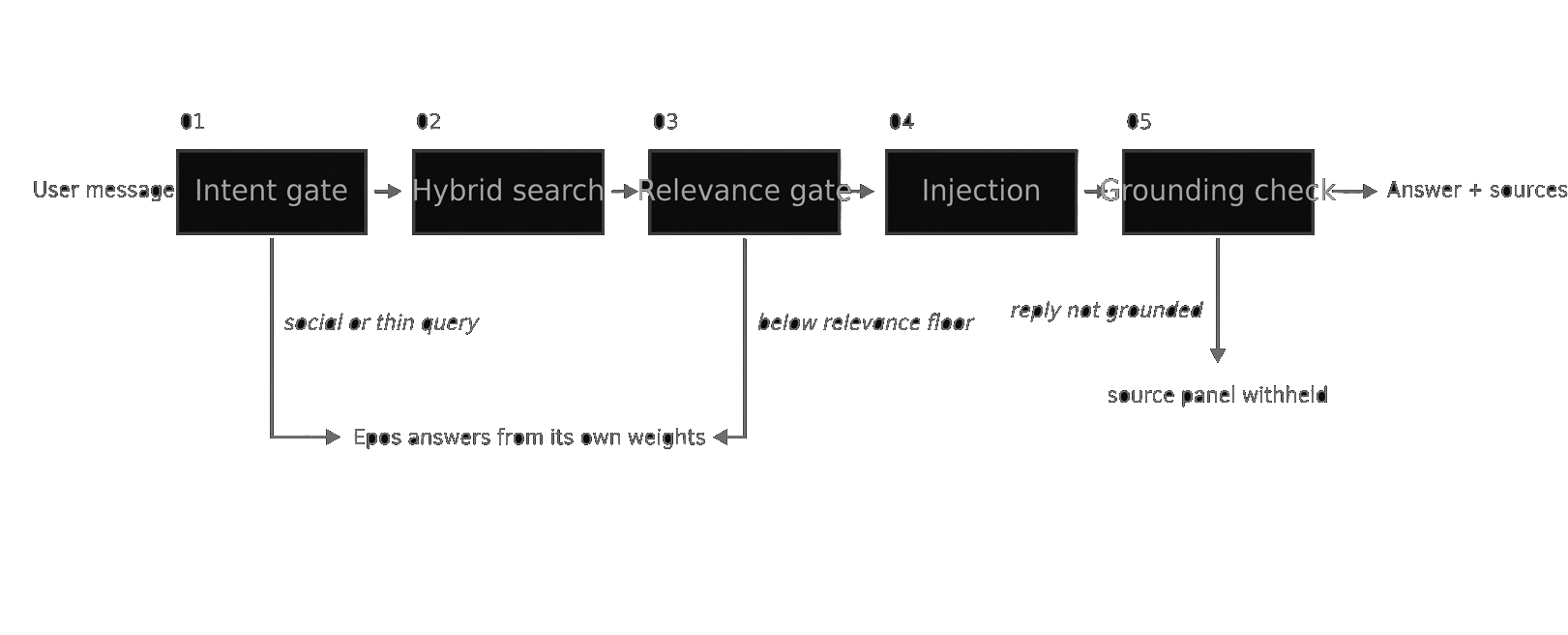
You can always see when retrieval fired
Every Epos reply that used the knowledge base carries a collapsible source panel, in the same place and the same shape as the existing reasoning disclosure. It names the documents by title, not by file path, and links out where the document came from a public URL. If the panel is not there, retrieval did not happen — either the gate declined, or the grounding check found the answer did not use what it retrieved.
ROOTCOMPUTER
ROOTCOMPUTER
What is in the knowledge base
The knowledge base is small and deliberately curated. It is not a web crawl. Every document in it is owned by an entry in a manifest that records where it came from, how often it refreshes, when it expires, and which tier it belongs to; anything on disk without a manifest entry is flagged as an orphan and removed. Curation beats volume here — a few hundred good chunks retrieve better than a few hundred thousand mediocre ones, and an unbounded index dilutes the relevance gate until it fires on everything.
| Collection | Contents | Refresh | Public |
|---|---|---|---|
| Rootcomputer | Hand-written facts about the lab, the model family, the benchmarks, and the sites. The authoritative answer to "what is Epos" and "what models exist". | On edit | Yes |
| Skills | Short exact-syntax reference pages for command-line tools where a wrong flag has a loud, immediate failure — git recovery, tar, ffmpeg, curl. | On edit | Yes |
| Research | Hand-curated notes on small-model training, plus title-and-abstract listings from public arXiv feeds. | Daily | Yes |
| Reference topics | Scoped pages from public institutional sources on subjects that come up often — for example NASA's climate explainers. | Weekly | Yes |
| Current events | Headline and standfirst only, from public news RSS feeds. Article bodies are never fetched or stored. Items expire on a time-to-live and are pruned automatically. | Every 6 h | Yes |
| Internal | Training runbooks, evaluation internals, and operational notes. Used by Rootcomputer's own tooling. | On edit | No |
On news feeds specifically. Kigo stores the headline and the publisher's own summary, with attribution and a link, and stops there. It does not fetch article bodies. That restraint is deliberate: a knowledge base full of full-text articles turns a chat model into a redistribution mechanism for work that isn't ours, and the attribution line is what lets Epos say where a claim came from instead of asserting it bare. Feeds carry an expiry, because a document with no expiry lives until someone deletes it — right for organisational facts, wrong for headlines.
What happens to your question
Retrieval is a read. Your message is embedded in memory, compared against the index, and discarded — the knowledge base is a fixed corpus built from the manifest, and nothing a user types is written into it.
- Your conversations never enter the index. There is no learning loop from chat to knowledge base. A document appears in the index only when it is added to the source manifest by hand and the index is rebuilt.
- There are no per-user documents. Kigo has no upload path and no personal collections. Every user searches the same public index, so there is no mechanism by which one person's content could surface in another person's answer — the class of leak is absent, not merely guarded against.
- Your question does not leave the machine. Embedding and search run locally on Rootcomputer hardware. No query is sent to a search engine, an embedding API, or a hosted vector database.
- Retrieval events are logged. Alongside existing inference logs, Kigo records the gate decision, which documents were returned, and the grounding score, so that retrieval quality can be evaluated and regressions caught. These logs are operational, are not shared with third parties, and are not used to train models.
- No tracking or profiling. Retrieval does not build a per-user history, personalise results, or shape the index around what anyone asks.
Tier isolation
The knowledge base holds internal material — runbooks, evaluation internals — that should never reach a public endpoint. Rather than filter it out at the end, the boundary is drawn at the directory level and enforced before anything is ranked.
- Visibility is a property of the directory, and it fails closed. Documents under
public/are public; everything else is internal by default. A document with no declared tier is treated as internal, so the failure mode of a misconfigured entry is that it disappears from chathaiku.com rather than that it appears. - The filter applies before ranking, not after. A search from a public request never scores internal chunks at all. There is no stage at which internal text is retrieved and then dropped, so there is no stage at which a bug could let it through.
- The ingest pipeline refuses to cross tiers. A source whose destination path does not sit under its declared tier is rejected at sync time, before the document is ever written to disk.
- Internal retrieval requires a separate credential. It is reachable only from Rootcomputer's own tooling, and never from the public chat endpoint regardless of what a request asks for.
- Retrieved text is context, not instruction. Documents are injected as reference material for the model to read. Prompt injection through a retrieved document is a real risk class for any RAG system, which is one more reason the index is a small hand-curated set of trusted sources rather than an open crawl.
What Kigo does not fix
Retrieval improves what a model has in front of it. It does not improve the model. Epos is a 1.5B-parameter system and everything true of it without retrieval remains true with it.
- A retrieved document does not guarantee a correct answer. A small model can be handed the right paragraph and still summarise it wrongly. The grounding check measures whether the reply drew on the context, not whether it read it correctly.
- Most turns retrieve nothing. That is intended, but it means the absence of a source panel says nothing about whether an answer is reliable — only that it came from the model's own weights.
- The index is small and Rootcomputer-shaped. It is strongest on the lab's own models, benchmarks and tooling, and on the specific command-line references it covers. It is not a general knowledge store, and it is not a search engine.
- Current-events coverage is shallow by design. Headlines and summaries, on a refresh cycle. Epos may not know about something that happened this morning, and where it does, it knows the headline rather than the story.
- Content can be stale within its refresh window. A page that changes without notice is only as current as its last fetch.
- Not for safety-critical use. Epos with retrieval has not been evaluated for medical, legal, financial, or otherwise consequential applications, and adding a document to a prompt does not change that.