What does it mean to be Human?
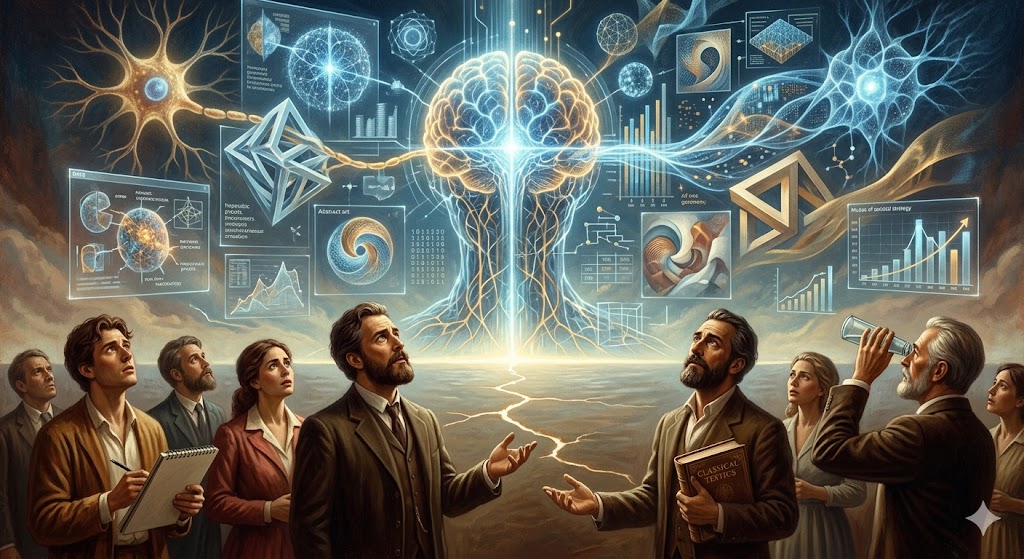
I look at the rise of advanced artificial intelligence and feel something deeper than ordinary concern. It is not just anxiety about jobs, or misinformation, or another wave of technological disruption. It is fear in a more fundamental sense. Fear that humanity is approaching a threshold unlike any it has ever crossed before, and that on the other side of it, the status quo our species has relied on for thousands of years may no longer exist.
What unsettles me most is not simply that AI will become useful, powerful, or even indispensable. It is that it may outclass us in the one domain that has always defined our place in the world: thought. Human beings have never been the strongest creatures, or the fastest, or the most durable. We survived and conquered because we could think. We could model the future, invent tools, coordinate in groups, tell stories, build civilizations, and transform the environment around us. Intelligence was not just one trait among many. It was our crown. It was the skill that guaranteed our dominance and, in many ways, our survival.
That is why this moment feels so psychologically catastrophic. If machines surpass us not just in calculation but in reasoning, creativity, strategy, scientific discovery, persuasion, and adaptation, then we are not merely witnessing a new tool entering history. We are witnessing the arrival of a rival mind, one that will eventually exceed the human mind in every measurable way. That possibility is unprecedented. We have no cultural instincts for it. No inherited wisdom for how to emotionally survive it. For all of human history, the smartest thing most people encountered was another human being. Soon that may no longer be true.
I think many people still fail to grasp the depth of this. They treat AI as another invention to absorb, another innovation that society will adjust to, just like we adjusted to everything else. But this is not like the steam engine, the internet, or the smartphone. Those technologies amplified human capacity. Advanced AI threatens to replace the human being at the very center of meaning-making itself. It threatens to make us spectators to our own obsolescence.
And I do not mean obsolete only in an economic sense, though that alone would be destabilizing enough. I mean obsolete in an existential sense. What happens to the human spirit when the machine writes better than the best poet, reasons better than the best philosopher, diagnoses better than the best doctor, strategizes better than the best trade experts, and invents faster than the top scientists? What happens when the average person begins to feel, with growing certainty, that the most important cognitive acts in society are no longer human acts? We are not prepared for the humiliation of becoming mentally second-rate in a world built by minds greater than our own.
That humiliation will not remain abstract. It will seep into culture, identity, and daily life. It will affect how children see their futures, how adults value their own skills, how communities define purpose, and how civilizations justify human worth. For centuries, people could endure hardship because there was still dignity in being necessary. But what happens when the machine is not just stronger, cheaper, and faster, but wiser in every practical sense? What happens when human excellence begins to feel quaint? Mundane? Meaningless?
I think the mental damage from that transition could be immense. We speak often about material displacement, but not enough about spiritual displacement. People are not built to gracefully accept the idea that their species has been surpassed at the very thing that made it special. Intelligence is not just what we do. It is what we believe we are. To lose dominance there is to suffer a kind of civilizational ego death. It means confronting the possibility that humanity was never the final author of meaning on Earth, only a temporary stage before something better arrived.
That is why I feel such dread when I think about the future. Not because I believe every outcome is certain, but because even the plausible outcomes are enough to shake the foundation of human self-understanding. The old world rested on a quiet assumption: that no matter how much history changed, humanity would remain the highest intelligence shaping it - the driver behind the wheel. If that assumption dies, then a great deal dies with it. Politics, work, education, art, ambition, even self-respect may all have to be renegotiated under conditions our ancestors never imagined.
I do not write this to fear mongor or come off as a cringe alarmist. I write it because I think the emotional seriousness of this moment is still being understated. There is something chilling about watching the approach of a force that may permanently alter the human condition while so many people continue to treat it as a novelty, a toy, or a convenience. It is not enough to ask what AI can do. We also have to ask what it will do to us, inwardly, when we are no longer the top thinkers in a universe we once believed belonged to us.
So I return to a question that feels more urgent now than ever: what does it mean to be human? If intelligence alone can no longer anchor the answer, then we may be forced to search for other foundations before the old ones collapse beneath us. Maybe dignity will have to come from something deeper than capability. Maybe worth will have to be defended on grounds machines cannot touch. Or maybe we are entering an era in which even that hope will be tested.
Either way, I cannot look at the emergence of advanced AI and see only progress. I see a existential wound opening in real time. I see the possible end of a human monopoly that has lasted for millennia. And I see, hanging over all of it, the terrifying possibility that the age of human intellectual supremacy is drawing to a close, and that we are far less ready for the psychological consequences than we pretend to be.